Your Website Has Two Audiences Now
Buyers and AI agents are both deciding whether your company belongs on the shortlist. The websites that win will be easy for machines to understand, and worth remembering by humans.
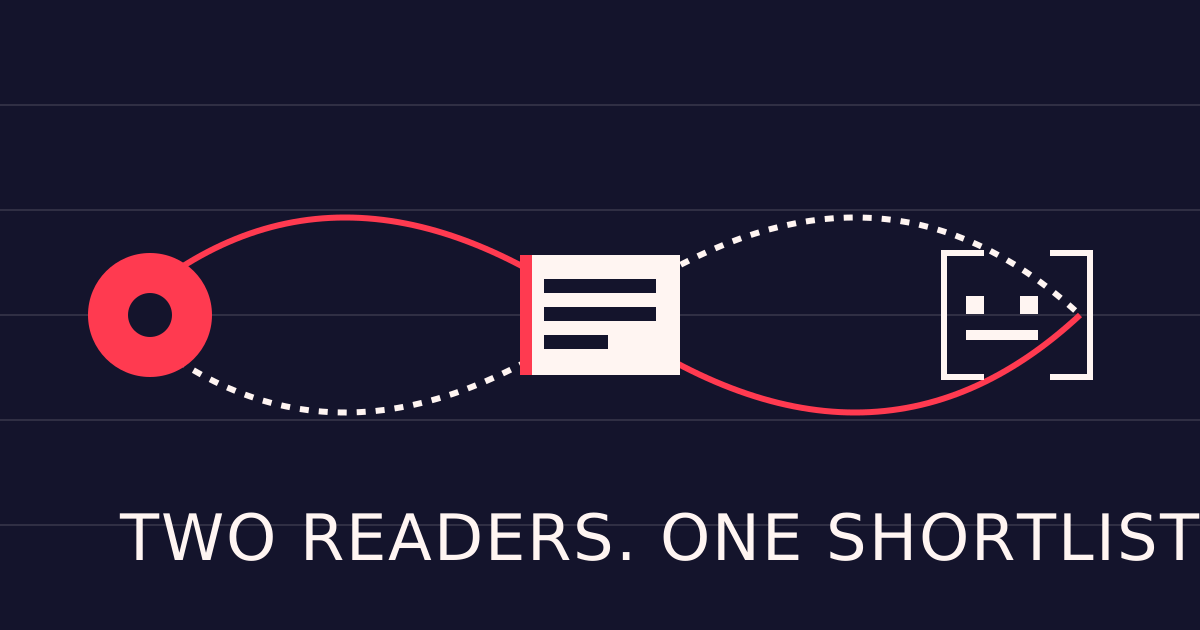
Most company websites were built for one audience: people.
A prospect lands on the homepage, reads the headline, scans the proof, visits a service page and decides whether the company deserves another ten minutes of attention.
That journey still happens. But it is no longer the only journey that matters.
Buyers are increasingly asking ChatGPT, Gemini, Perplexity and AI-powered search tools to research problems, compare vendors and explain unfamiliar categories. Before a potential customer visits your website, an AI system may already have read it, interpreted it and decided whether your company belongs in the answer.
Reader one
A person
Reader two
Software
Your next website visitor may not be a person.
It may be software gathering evidence on a person’s behalf.
That gives your website a second audience. It still needs to persuade a human, but it also needs to give machines a clear, accurate account of what your company does, who it serves and why anyone should believe it.
This is not a technical SEO edge case. It is becoming a basic requirement of digital marketing.
01 / Clarity
AI Visibility Is a Clarity Test
When a person encounters a vague website, they can sometimes fill in the gaps.
They may recognize a customer logo, understand the industry language or infer what the company does from a product screenshot. An AI system has less patience for implication. It extracts information, compares claims and looks for evidence it can use in an answer.
If your homepage says that you “unlock transformation through intelligent innovation,” the problem is not that an AI cannot read the sentence.
The problem is that the sentence contains almost nothing to understand.
The same is true for websites full of category language but short on specifics. “AI-powered.” “Next-generation.” “Seamless.” “Built for the future.” These phrases may sound appropriate in a brand workshop, but they do not tell a buyer, or a machine, what the product does.
A clear website should answer five questions without making either audience work for them:
- What does the company sell?
- Who is it for?
- What problem does it solve?
- How is it different?
- What evidence supports the claim?
If those answers are scattered across six pages, hidden in a video or buried below three screens of abstract messaging, you do not have an AI visibility problem.
You have a positioning problem.
02 / Risk
Generic In. Generic Out.
The biggest risk is not that AI systems will ignore your company completely.
It is that they will describe it accurately as generic.
This is especially common in B2B technology. Visit ten websites in the same category and you will often find the same claims presented in slightly different colors: faster deployment, better visibility, increased efficiency and enterprise-grade security.
An AI assistant asked to compare those companies has very little distinctive material to work with. It can repeat the feature lists, summarize the service pages and mention the industries displayed in the navigation. It cannot manufacture a meaningful position that the company has not made clear itself.
This is what many teams misunderstand about AI search.
They assume the goal is to make more content available to machines. In reality, most companies already have more than enough content. What they lack is a consistent point of view worth extracting from it.
Publishing another article titled “Five Trends Transforming Our Industry” will not solve that problem. It adds more interchangeable language to a market already buried in it.
A machine can summarize commodity content perfectly.
That does not make the content valuable.
03 / Method
Do Not Build a Second Website for Robots
A new industry has emerged around Generative Engine Optimization, usually shortened to GEO. Some of the advice is useful. Much of it is conventional SEO wearing an AI badge.
The temptation is to treat AI visibility as a separate technical discipline: create special files, break every page into tiny fragments, repeat questions in a particular format and rewrite the website for machines.
Google’s own guidance is considerably less dramatic.
Its official guide to generative AI search says established SEO practices remain the foundation. It emphasizes crawlable pages, clear technical structure, useful organization and original, non-commodity content. It also says websites do not need special AI markup, artificial “chunking” or copy written specifically for generative systems.
That is less exciting than discovering a secret GEO hack. It is also more useful.
The qualities that make a page easier for an AI system to interpret generally make it better for a person to use:
- Clear headings
- Specific language
- Logical page structure
- Accessible text
- First-hand expertise
- Verifiable claims
- Relevant images and video
- Fast, reliable performance
You do not need one website for people and another for machines.
You need one website that communicates without hiding behind ambiguity.
04 / People
The Human Audience Still Makes the Decision
Making a website machine-readable does not mean draining it of personality.
An AI assistant may create the shortlist, but a person still needs to trust the company on it.
They will look at the quality of the work, the credibility of the team and the confidence of the point of view. They will notice whether the site feels considered or assembled from the same template as every competitor. They will decide whether the company understands their world or has simply learned its vocabulary.
Brand matters more in an AI-mediated journey because the shortlist may become shorter, not longer.
Research from LinkedIn and the Ehrenberg-Bass Institute found that buyers evaluating generative AI products considered only 2.4 brands on average. The specific number will vary by category, but the implication is useful: buyers do not carefully evaluate every available option. They begin with a small set of companies that are already visible, recognizable or easy to understand.
Machines reward explicitness.
People remember distinction.
A website needs both.
A site designed only for machines becomes a knowledge base. It may contain every relevant fact while giving a buyer no reason to care.
A site designed only for visual impact becomes a mood board. It may create an impression while giving both audiences too little substance to evaluate.
The work is to make the company easy to parse and difficult to forget.
05 / Checklist
What an AI-Ready Website Actually Needs
This does not require rebuilding every page. It requires being more disciplined about what each page is supposed to communicate.
1. A position that survives summarization
Read your homepage headline without the supporting animation, product interface or sales explanation.
Does it still say something meaningful?
A strong position should survive being reduced to one sentence. If an AI assistant summarizes your company, the result should resemble the way your best salesperson would describe it.
If the summary could describe five competitors equally well, the positioning is not finished.
2. One clear job for every page
A service page should explain the service. A product page should explain the product. A case study should prove an outcome.
Too many websites force every page to do everything: introduce the company, tell the founder story, explain four products, collect an email address and rank for twelve search terms.
The result is a page with no center of gravity.
Give every important page one primary subject, one intended audience and one next action.
3. Proof that can be inspected
Claims are easy to generate. Evidence is harder.
Replace “we deliver measurable results” with the result. Replace “trusted by leading companies” with a specific example of what was delivered. Replace an anonymous testimonial with a named person, role and company whenever possible.
Good case studies explain the situation, the constraint, the decision and the outcome. They give human buyers confidence and give AI systems concrete evidence to cite.
The specificity is the proof.
4. Content that contains something original
AI systems can already produce competent summaries of common knowledge. Publishing another version gives them little reason to reference yours.
The content most likely to remain valuable comes from experience:
- A process you have tested
- A decision you would make differently
- A result that challenged an assumption
- A framework you use with clients
- A strong opinion supported by evidence
- A detailed look at work that succeeded or failed
Google calls this “non-commodity content.” We would call it having something to say.
5. Important information in accessible formats
A beautiful animation may explain the product perfectly to someone watching it. That does not mean every search system or browser agent can interpret it reliably.
Do not hide essential information exclusively inside videos, images, interactive components or downloadable PDFs. Support those experiences with clear text on the page.
The goal is not to remove rich media. Images and video can strengthen both human understanding and search visibility. The goal is to make sure the central message does not disappear when the presentation layer is removed.
6. Consistency beyond the website
AI-generated answers may draw from your site, customer reviews, social profiles, industry publications, videos and other public sources.
If every source describes the company differently, the system has to reconcile the inconsistency. Sometimes it will do that badly. Sometimes it will favor a clearer competitor.
Your category, audience and primary claim should remain recognizable wherever the company appears. This does not mean repeating identical copy everywhere. It means building a position strong enough to survive different formats and voices.
06 / Test
Run the Five-Question Test
There is a simple way to find out whether the website is doing its job.
Give someone who does not know the company two minutes on the site. Then ask:
Run the same test with several AI assistants. Ask each one to describe the company using only information it can find publicly.
Then compare the answers.
If the person and the machines reach different conclusions, find the source of the confusion. If none of them can identify a meaningful difference, do not start by adjusting metadata. Fix the position.
This test will not tell you exactly how every model represents your company. These systems change constantly, and no outside platform has complete access to their internal ranking logic.
It will tell you whether your public story is coherent.
That is the part you control.
07 / Shift
The Website Is Becoming a Source, Not Just a Destination
Marketing teams have traditionally treated the website as the place where the buyer arrives.
AI search changes that role.
Your website is also becoming source material for answers delivered somewhere else. A buyer may learn about your product without opening a page. They may encounter your claim inside a comparison, summary or recommendation assembled by a system you do not control.
This complicates measurement. Fewer journeys will move cleanly from search result to landing page to form submission. Brand mentions, citations and inclusion in relevant answers will matter alongside rankings and traffic.
The IAB’s 2026 industry outlook identifies adapting to AI-driven consumer behavior as a leading challenge for media buyers. It also shows growing attention to optimizing content for AI-generated answers and measuring performance across platforms.
The old dashboard will not disappear. It will become less complete.
That makes a clear, memorable brand even more important. When the first interaction happens somewhere you cannot fully see, buyers need to remember enough to find you again.
08 / Conclusion
The Takeaway
Your website still has to make a human choose you.
Now it also has to give a machine enough clarity and evidence to include you in the conversation.
Those are not opposing goals. They are the same standard being applied by two different readers.
Be specific about what you do. Build pages around real buyer questions. Publish experience instead of summaries. Make evidence easy to find. Use design to strengthen the message rather than compensate for the absence of one.
The companies that win will not be the ones that write most aggressively for algorithms.
They will be the ones that are easiest to understand, and hardest to confuse with anyone else.